What Are the 5 Methods of Mixing?
News Details
In commercial baking, mixing is far more than just stirring ingredients together. It is a precise physical process that builds structure, incorporates air, and blends flavors evenly. Whether you run a wholesale bakery, a pizza factory, or a large food plant, choosing the right method—and the right industrial food processing equipment—is crucial for final product quality.
So, what are the 5 methods of mixing used in professional kitchens and industrial facilities?
In this article, we explain the core mixing techniques every baker needs to know. We also explore how food manufacturing automation and WuxiHenghao Bakery (Haopai Auto)equipment elevate baking results across large operations.
1. The Creaming Method: Building Air and Texture
The creaming method is a fundamental technique used for cakes, cookies, and sweet doughs. In this process, solid fat (like butter or shortening) is beaten together with sugar until the mixture becomes light and fluffy.
-
How It Works: As the agitator spins, sharp sugar crystals rub against the fat, trapping tiny air pockets inside the mixture.
-
Why Equipment Matters: While home bakers look for the best stand mixer for bread dough or cakes, commercial operations need steady speed control. Using a planetary mixer with a flat beater agitator ensures rapid cream formation without scorching or over-friction.
2. The Rubbing-In (Cut-In) Method: Creating Flaky Layers
The rubbing-in method—often called cutting in—combines cold fat into flour until the mixture resembles coarse crumbs. This technique is key for flaky pastries, pie crusts, and biscuits.
-
How It Works: The fat pieces are coated in flour rather than fully dissolved. When baked, the fat melts and creates steam pockets, producing delicate, flaky layers.
-
Industrial Application: After initial dough prep, bakeries pass dough through an electric dough sheeter to laminate and fold these delicate layers smoothly without overworking the gluten.
3. The Creaming-and-Folding (Whipping) Method: Aerating Batters
When products require extreme volume—such as sponge cakes, meringues, or whipped toppings—bakers rely on the whipping method.
-
How It Works: Liquid eggs or egg whites are whipped at high speeds to entrap air bubbles, creating a stable foam structure.
-
The Right Tool: A planetary mixer fitted with a whipping wire ball delivers the fast action required to whip light liquids into stiff peaks in minutes.
4. The Folding Method: Blending Without Deflating
The folding method gently combines a light, aerated foam (like whipped cream or egg whites) into a denser batter.
In professional baking setups, each mixing method relies on a specific motion to achieve its desired outcome. The creaming technique beats fat and sugar with a flat beater to build a light structure, while the rubbing-in method cuts fat into flour to create delicate, flaky layers. For high-volume aeration, the whipping method uses a wire ball at fast speeds to trap air in liquids. To preserve these fragile air bubbles, the folding method gently blends light foams into denser batters at low speeds. Finally, for yeast breads, the kneading method uses a spiral hook to stretch dough, developing the continuous gluten network needed for high rise and ideal texture.
5. The Kneading Method: Developing Gluten for Bread
For yeast-raised breads, baguettes, and buns, kneading is the most important step.
-
How It Works: Kneading stretches and folds wet flour proteins (gliadin and glutenin) into a continuous gluten network. This network traps carbon dioxide gas produced by yeast, giving bread its chewy crumb and tall rise.
-
Large-Scale Production: Kneading heavy bread dough requires immense motor torque. Operations rely on continuous mixing lines or heavy-duty spiral hooks to handle stiff dough without stalling or over-heating the batch.
Featuring Wuxi Henghao’s Planetary Mixers for Bakeries
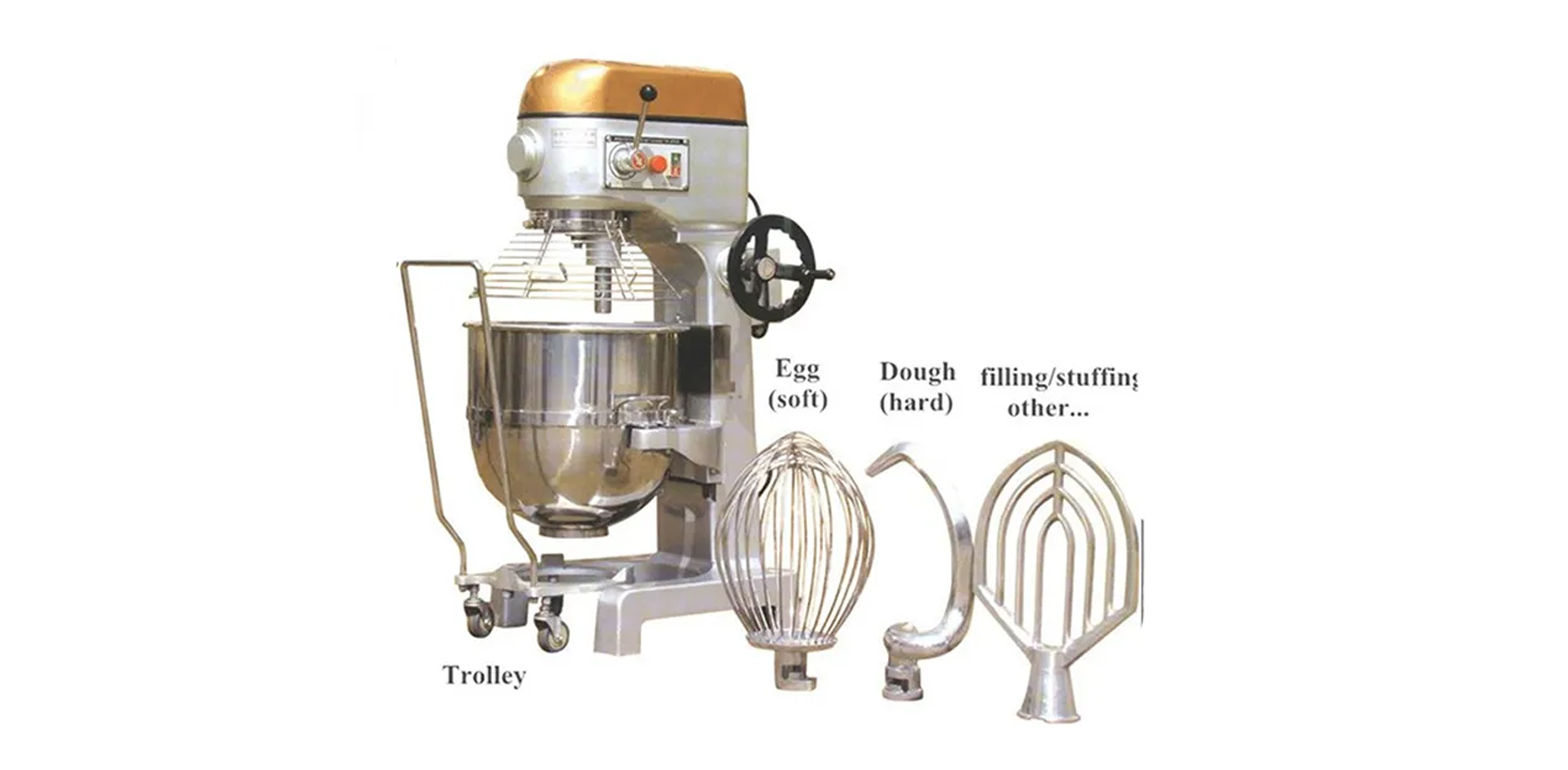
To execute all 5 mixing methods effortlessly, commercial kitchens need versatile machinery. Wuxi Henghao’s planetary egg mixers from Henghao Bakery (Haopai Auto) combine precision engineering with food-safe durability.
Wuxi Henghao provides a complete planetary mixer lineup to match varying production needs. Compact 20L and 40L benchtop or floor models serve medium-sized bakeries with multi-speed transmissions and three versatile agitators. For large industrial operations, heavy-duty 60L and 80L trolley models integrate removable bowl trolleys, allowing workers to transport heavy batches across the factory floor quickly and safely.
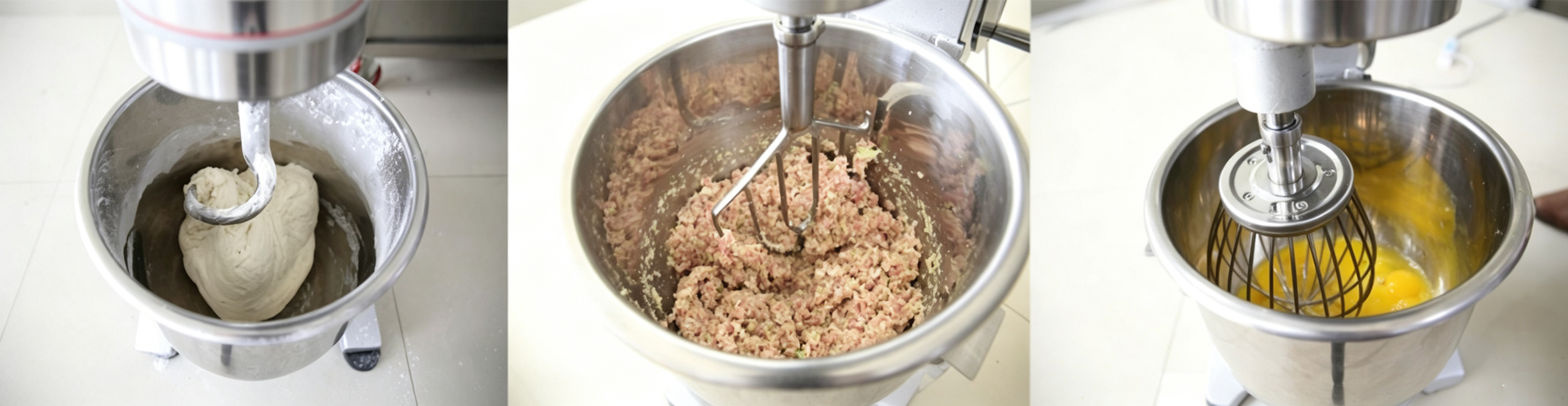
Equipped with 3 interchangeable agitators (flat beater, spiral hook, and whipping ball), these units deliver uniform mixing for eggs, heavy dough, whipped cream, and light batters while fully complying with global food safety standards.
Technical Specifications: Wuxi Henghao Planetary Mixers
| Model Capacity | Speed Settings (RPM) | Agitators Included | Power & Voltage | Machine Weight |
| 20L | 131 / 288 / 518 | Beater, Hook, Whipping Ball | 220V / 380V | 83 kg |
| 40L | 120 / 240 / 468 | Beater, Hook, Whipping Ball | 220V / 380V | 162 kg |
| 60L (with Trolley) | 112 / 214 / 415 | Beater, Hook, Whipping Ball | 220V / 380V | 320 kg |
| 80L (with Trolley) | 106 / 186 / 365 | Beater, Hook, Whipping Ball | 220V / 380V | 630 kg |
The 60L and 80L models feature built-in bowl trolleys, making it easy for workers to transfer heavy batches across the factory floor without manual lifting.
Complete Factory Automation with Henghao Bakery (Haopai Auto)
Beyond standalone mixing units, Henghao Bakery (Haopai Auto) manufactures complete turn-key lines for modern food manufacturing automation:
-
Industrial Bread Making Machine Lines: High-speed multi-stage forming lines like the HM-1510 series, capable of producing up to 650 pieces per minute.
-
Danish Pastry Production Lines: Continuous sheeting lines built for high-output croissant and puff pastry laminating.
-
Encrusting Machines: High-precision filling and shaping systems for stuffed buns, cookies, and mooncakes.
-
Cake Aeration Systems: Pressurized continuous aeration machinery designed for uniform cake batters and sponge production.
-
Cake & Cookies Machines: Depositors and wire-cut depositors for high-speed cookie manufacturing.
-
Dim Sum Machinery: Specialized equipment for traditional steamed buns and dumplings.
How to Choose the Best Industrial Bread Making Machines for Large Bakeries
When upgrading your production line, matching your equipment to your mixing method is essential:
-
Assess Batch Size: Small shops benefit from 20L or 40L planetary mixers, whereas wholesale industrial bakeries require 60L–80L trolley models or continuous production lines.
-
Prioritize Speed Flexibility: Choose machines with clear RPM stages (such as 112/214/415 RPM) so operators can whip, cream, or knead on a single machine.
-
Invest in Complete Line Integration: Pair your mixers with automated dough sheeters, proofer systems, and packaging tools to boost yield and cut down labor costs.
By matching the right mixing technique with durable equipment from Henghao Bakery (Haopai Auto), food processors achieve consistent quality, high hourly yields, and smoother daily factory operations.
FAQ
Q1: Why is a planetary mixer called "planetary"?
The agitator rotates on its own axis while simultaneously orbiting around the center of the bowl—similar to how planets orbit the sun. This dual movement reaches every point inside the bowl for thorough, streak-free mixing.
Q2: What is the main difference between a spiral mixer and a planetary mixer?
A spiral mixer rotates the bowl while keeping the hook stationary, making it best suited for heavy yeast doughs. A planetary mixer keeps the bowl fixed (or raised) and moves the tool, allowing it to handle multiple tasks like whipping, creaming, and light dough mixing using different agitators.


