Automatic Croissant Production Line: A Buyer's Guide to Laminating, Cutting, and Forming
News Details

Making a golden, flaky croissant on a massive scale is both a fine art and a serious science. Traditional craft bakers rely on human hands to fold butter into dough, roll it out, cut neat triangles, and shape each piece one by one. However, when your commercial bakery needs to ship tens of thousands of uniform pastries every single day, hand methods are simply too slow and costly.
This is where a modern automatic croissant production line changes the game. By automating the core stages of lamination, precision cutting, and curling, large-scale bakeries achieve remarkable product consistency while slashing labor costs.
Whether you are upgrading an existing facility or building a new factory floor from scratch, this buyer’s guide breaks down everything you need to know about purchasing an industrial croissant machine.
Why Upgrade to an Automatic Croissant Production Line?
Baking high-quality pastries demands total control over temperature, dough thickness, and time. If your dough gets too warm during rolling, the butter layer melts into the flour structure. As a result, you lose those crisp, distinct flaky layers that consumers love.
By switching to a fully automated system, you solve these classic production bottlenecks in several key ways:
-
Unmatched Output Speed: Automated setups process hundreds of kilograms of dough every hour without slowing down.
-
Uniform Product Weight: Advanced digital sensors make sure every croissant matches your exact weight specs.
-
Reduced Human Contact: Fewer hands on the dough means cleaner hygiene standards and lower risk of contamination.
-
Lower Operating Costs: Automation allows a lean crew to oversee a high-capacity production output.
Leading equipment innovators like Henghao Bakery (Haopai Auto) design automated system layouts specifically to protect delicate pastry structures while delivering heavy-duty industrial performance.
Step 1: The Science of Laminating on an Industrial Croissant Machine
Lamination is the heart of all viennoiserie baking. During this stage, continuous sheets of cold dough and butter blocks are folded together into delicate, alternating layers. When the pastry bakes, water inside the butter evaporates into steam. This steam expands and pushes the dough layers apart, creating the classic honeycomb interior structure.
1. Stress-Free Dough Sheeting
First, the dough block enters a series of rolling stations. A quality industrial croissant machine uses gentle, progressive reduction rollers rather than force. Because heavy pressing damages gluten strands, stress-free rollers stretch the dough slowly to preserve its elasticity.
2. Precise Butter Infolding
Next, an automated butter pump or butter sheet dispenser places a uniform layer of chilled butter directly onto the dough belt. The margin of error here must be near zero. If the butter is too soft, it smears; if it is too hard, it breaks through the dough skin.
3. Multi-Stage Folding and Cooling
After infolding, satellite rolling heads and folding shoes turn the single sheet into double or single book folds. Modern production lines often pass the laminated dough belt through continuous cooling tunnels. Consequently, the butter stays at its ideal working temperature before reaching the cutting station.
Step 2: High-Precision Cutting in a Modern Viennoiserie Production Line
Once your dough reaches its target thickness and layer count, it moves rapidly toward the cutting zone. Achieving clean, crisp edges during cutting is essential. Otherwise, sealed or squished edges will prevent the pastry layers from rising properly in the oven.
A high-speed viennoiserie production line uses multi-stage rotary cutting tools to prepare the dough belt:
-
Edge Trimming: Rotary knives slice off uneven dough margins on both sides, returning scrap dough cleanly to a recycle chute.
-
Longitudinal Slicing: Parallel blades cut the broad sheet into long, even strips.
-
Triangular Cutting: Specialized rotary dies cut opposite diagonal lines, creating uniform triangular dough pieces.
-
Triangular Turning: Automated turning devices rotate alternating triangles so that all pieces face the same direction down the belt for forming.
Furthermore, premium cutting units use non-stick coatings and precision optical registration. This prevents sticky dough from snagging on the blades, ensuring clean cuts hour after hour.
Step 3: Rolling and Forming with an Automatic Croissant Production Line
The final mechanical step before proofing and baking is forming. Turning flat dough triangles into neatly curled croissant crescents requires delicate handling and accurate speed alignment.
1. Tail Stretching
Before rolling begins, gentle gripper belts gently pull the tail end of each dough triangle. Stretching the triangle lengthens the piece, which increases the total number of turns when rolled. More turns yield a richer, more attractive final appearance.
2. Guided Curling Belts
Next, the base of the triangle enters a set of counter-rotating mesh chains or textured belts. As the dough advances, these curling chains lift the wide edge and roll it tightly forward toward the narrow tip.
3. Adjustable Curling Pressure
Different recipes require different roll tightness. For instance, filled croissants (like chocolate or custard crescents) need a slightly looser roll so filling does not spill out during baking. Modern machines allow operators to adjust curling pressure instantly via digital touchscreens.
For bakeries seeking high-volume output and maximum flexibility, investing in a robust, multi-functional system like the Haopai Auto Complete Industrial Croissant Viennoiserie Production Line ensures you can switch seamlessly between standard crescents, mini croissants, and specialty filled puff pastries.
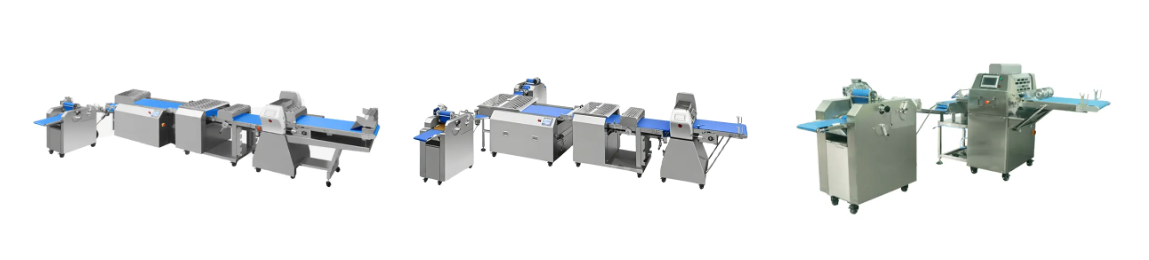
Key Features to Look for in an Industrial Croissant Machine
When evaluating equipment suppliers, look past basic price tags and focus on long-term engineering quality. Here are the core features every commercial buyer should verify:
| Feature Category | Key Requirement | Why It Matters |
| Frame & Hygiene | Full 304 Stainless Steel Construction | Prevents rust, withstands washdowns, meets food safety rules. |
| Control System | Siemens / Allen-Bradley PLC Touchscreen | Stores recipe presets, allows quick adjustments, tracks errors. |
| Belt Technology | Quick-Release Food-Grade PU Belts | Makes daily sanitation and washdowns fast and hassle-free. |
| Modular Design | Interchangeable Cutting & Filling Heads | Enables quick shape changes (e.g., pain au chocolat, Danish). |
| Dough Protection | Stress-Free Calibrators & Cooling Tunnels | Keeps delicate butter layers intact throughout high-speed runs. |
In addition, consider factory floor space and utility access. A full-scale viennoiserie production line can range from 15 meters to over 40 meters in total length. Therefore, measuring your facility headroom, electrical supply, and compressed air availability early on will save you costly installation delays.
Choosing Henghao Bakery (Haopai Auto) for Your Viennoiserie Production Line
Selecting the right manufacturing partner is just as critical as choosing the machine itself. Henghao Bakery (Haopai Auto) has earned a strong global reputation for engineering high-performance automated bakery solutions tailored to international production demands.
Here is why industrial food producers choose Haopai Auto:
-
Customized Layouts: Every production line is custom-configured to match your floor plan and hourly tonnage requirements.
-
Precision Servomotors: Multi-axis servo drives synchronize belt speeds smoothly across laminating, cutting, and curling zones.
-
Turnkey Support: From initial engineering drawings and installation to operator training and spare parts, Haopai Auto offers comprehensive end-to-end service.
By partnering with an experienced manufacturer, you gain access to customized machine configurations that grow alongside your business.
Conclusion: Final Buyer's Checklist
Investing in an automatic croissant production line is a strategic move that elevates product consistency, boosts daily output, and protects your operational margins. To make the best purchasing decision for your bakery, keep this simple checklist in mind:
-
Calculate Your Target Capacity: Determine your required hourly kilogram output and desired croissant weight ranges.
-
Audit Your Recipe: Ensure your dough and butter formulations align with automated stress-free laminating units.
-
Inspect Sanitation Access: Choose machines with tool-less belt removal and open stainless-steel frames for fast cleaning.


