Energy-Efficient Bakery Production: Where the Kilowatts Go and How to Cut Them
where bakery energy actually goes — ovens, provers, cooling and standby loss — and the measurement, equipment and scheduling changes that reduce kilowatt-hours per kilo of dough.
2026/11/18
Reading volume: 0
News Details
Summary: In most bakeries the ovens dominate the energy bill, and the rest is lost in the places nobody measures: provers running longer than the recipe needs, fans extracting conditioned air, heat escaping through thin insulation and idle standby time. Energy-efficient bakery production starts with one number — kilowatt-hours per kilo of dough — and improves it through measurement, equipment specification and scheduling, usually without touching the recipe.
In this guide: why a benchmark beats a utility bill, how to calculate oven energy consumption, which specification details move the number, where standby and schedule waste hide, whether waste heat recovery pays, when an upgrade pays back, and what to send a supplier for an energy-focused quotation.
Why Start With a Benchmark, Not a Utility Bill?
A monthly utility bill tells you what the whole building consumed. It cannot tell you whether the bakery department performed well, because it mixes production energy with lighting, offices and refrigeration. The working unit for bakery energy management is simpler: energy consumed per kilogram of dough produced.
Widely cited industry benchmark studies have suggested a target in the region of 0.75 kWh per kilogram of dough for mid-size operations producing around 10,000 tonnes a year, with smaller plants typically running proportionally higher. The exact figure matters less than the method: once the bakery has its own kWh/kg baseline, it can be tracked monthly, and every operational change — a new oven, a shift pattern adjustment, a maintenance campaign — can be judged against it instead of against intuition.
Getting that number requires a submeter on the bakery section. A single clamp meter and a production record are usually enough to start; without them, energy conversations stay anecdotal and capital requests stay unproven. This is the first step of any practical bakery energy audit, and it costs far less than the equipment decisions it informs.
How Do You Calculate Bakery Oven Energy Consumption?
For a batch oven, three lines are enough:
- Energy per batch (kWh) = rated heating input (kW) × bake time (h)
- Energy per kilo (kWh/kg) = energy per batch ÷ batch weight (kg)
- Plant-level kWh/kg = total metered energy ÷ total dough output
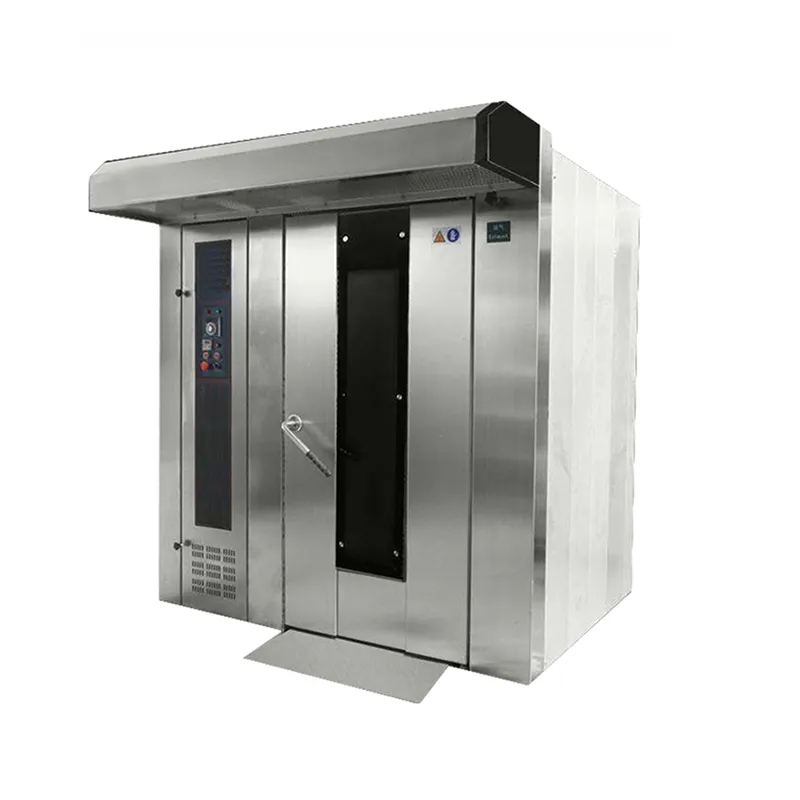
Example: a 54 kW rotary rack oven running a 30-minute cycle on a 67 kg batch of tin bread works out at roughly 0.40 kWh per kilo for the bake itself. The plant-level figure will be higher — provers, mixers, cooling, extraction and standby all sit on top of that number — which is why comparing a single machine figure against a plant benchmark is a mistake. Compare like with like.
The same calculation makes quotations comparable. Two ovens with the same tray count but different insulation, air management and recovery behaviour can differ substantially in real consumption, and the rated input alone will not reveal it. For a fuller treatment of how oven choice affects the rest of the line, see our rotary rack oven guide, including the capacity and energy calculations behind a batch bake.
Which Specification Details Actually Move the Number?
Rated power is the least informative line on an oven quotation. Four specification details do more work:
| Detail | Why it matters | What to look for |
| Insulation | Standby and shell losses run every minute the oven is hot, not just during bakes | Insulation type, thickness and density — for example the HM-32 series uses 135 mm rock wool at 100 kg/m³ |
| Heat recovery between batches | A heavy heat exchanger returns heat to the next batch instead of venting it | Recovery time quoted by the supplier, not just heat-up time |
| Air management | Running the circulation fan flat out for delicate products wastes both fan power and product moisture | Two fan speeds or variable frequency control, with adjustable dampers |
| Doors and seals | Damaged seals leak heated air continuously and quietly | Seal condition on the inspection list, and a replacement interval |
Maintenance belongs in the same conversation. Clean elements and reflective surfaces radiate better; a monthly cleaning routine is normally sufficient. These are small items, but they act directly on oven standby heat loss — the consumption that happens when nothing is being baked.
Where Does Schedule Waste Hide?
Equipment specification sets the ceiling; scheduling decides how much of it you use. Three habits account for most of the avoidable loss:
- Starting early. Ovens and provers switched on ahead of the first batch burn energy into empty space. Preheat windows should match the proofing schedule, not the shift start time.
- Spreading the load. Two ovens at half load consume more than one oven running consecutive batches, because every hot chamber pays standby loss. Batch planning should aim to run as few ovens as possible for as short a time as possible.
- Idle decks and idle fans. Unused decks and extraction fans should be off, not idling. Variable speed drives on extraction, linked to oven doors or room temperature, stop the ventilation system from removing conditioned air all day.
Scheduling also has a capacity angle. A line that is badly balanced idles its most expensive section — usually the oven — and idle oven time is pure loss. This is why capacity calculation is as much an energy exercise as a throughput exercise.
Can Waste Heat Recovery Pay Back?
Oven exhaust carries usable heat. Recovering it to preheat incoming combustion air, or to warm process water, is one of the few upgrades that reduces consumption without changing production behaviour. Commonly cited figures place the saving in the range of 10 to 15 percent where the production pattern is steady enough to keep the recovery loop busy.
The qualification matters: waste heat recovery suits lines with long, continuous production. A bakery that runs short batches with long gaps between them will recover little, because the heat is mostly generated and lost in bursts. Assess the production pattern before the hardware.
When Does an Upgrade Pay Back?
A simple illustration, with all figures assumed: suppose an older oven loses 4 kW continuously through shell and standby losses over 16 operating hours a day, 300 days a year. That is about 19,000 kWh a year. At an electricity price of 0.12 per kWh, the leakage alone costs roughly 2,300 a year — before it has baked anything. If better insulation and door seals eliminate most of that loss, the payback calculation becomes concrete rather than rhetorical.
The same arithmetic applies to fan upgrades, extraction controls and scheduling changes. None of them are dramatic individually; together they move the kWh/kg benchmark, which is the number that proves the saving to management. For the wider picture of what drives line investment returns, our article on bakery production line cost factors breaks the price of a line into the components that matter.
What Should You Send for an Energy-Focused Quotation?
- Products and output: piece weights, target hourly output, shift pattern.
- Bake profiles: times and temperatures you currently run.
- Heat source available on site — electric, gas or diesel — and local energy tariffs.
- Current consumption data if the bakery is submetered, including the kWh/kg figure.
- Building data: power supply capacity, ceiling height, hood and exhaust arrangement.
- Production pattern: continuous runs or short batches, because it decides whether heat recovery is worth specifying.
With those six items, a supplier can quote consumption behaviour alongside price — which is how bakery oven energy consumption becomes a purchase criterion instead of a surprise.
Final Thought
Energy efficiency in a bakery is rarely one big decision. It is a measured benchmark, an oven specified for insulation and air management, a schedule that does not heat empty space, and a maintenance routine that keeps seals and surfaces doing their job. Start by metering the bakery section for one month. The number you get will justify — or kill — every upgrade idea on the list, in order of payback rather than in order of persuasion.
Energy-Efficient Equipment from Haopai
The HM-32 series rotary rack oven is built with 135 mm rock wool insulation at 100 kg/m³, three-stage air adjustment, fast and slow fan speeds, and optional variable frequency air control and a dual steam system — the specification points that act directly on standby loss and per-kilo consumption. It is normally specified together with an automatic spiral dough mixer upstream and an automatic flow packing machine downstream, as part of complete bakery production lines designed so that no section waits idle on another. Haopai equipment is CE and ISO certified, with overseas installation and after-sales support.
Planning an Energy Review for Your Bakery?
Send your product list, target output and current energy data — or just your product range and shift pattern if the bakery is not yet metered — and we will return a configuration with the consumption logic behind it, including the right rotary oven or turnkey bread production line for your bake. For the project-level view, our guide to the turnkey bakery production line shows where an energy review fits into layout and utility planning.
Share to:


