Rotary Rack Oven: Working Principle, Applications, and Design Limits
**How a rotary rack oven works** - Combustion air fan → burner (gas/oil) or electric elements → hot-air circulation system with side or rear fans and baffles → rotating rack/spider that turns during baking so every product sees the same airflow - Exhaust flue with damper controls moisture release, humidity during oven spring, and steam injection if fitted - Controls set temperature, time, rack speed, humidity profile, and sometimes programmed baking curves for different products **Where it beats deck and tunnel ovens** - Flexibility: handles bread, pastries, cakes, trays, tins, and varying batch sizes without reconfiguring a tunnel line - Space efficiency: high loading density per square meter of floor space compared with deck ovens - Consistent bake across varied products because the rack rotates and air circulates uniformly - Labor efficiency: one operator can load/unload full racks, reducing handling time - Batch-to-batch control: ideal for artisan, small-batch, and mixed-output bakeries **Calculating batch capacity** - Rack height × usable width × usable depth gives oven chamber volume and usable loading area in meters - Multiply by trays or baskets per rack, then by units per tray (from product dimensions and tray size) - Multiply by racks per bake cycle and cycles per hour (60 ÷ bake time in minutes) - Capacity per hour = trays × units per tray × racks per cycle × cycles per hour **Energy per kilo** - Record fuel or electricity consumed per full bake cycle, and the weight of product baked - Energy per kilo = total energy input (kWh or MJ) ÷ total product output in kg - Include preheat amortized over production hours, and compare at the same product mix, loading density, and oven temperature **Cases where a rack oven is the wrong choice** - Very high-volume single-product lines where a tunnel oven delivers lower unit cost - Products requiring direct hearth contact, stone-deck flavor, or specific bottom-heat profiles - Continuous 24/7 production where batch loading/unloading becomes a bottleneck - When labor cost is extremely high and automated conveying is essential - If you need extremely small batches with minimal residual heat loss—a deck or convection oven may be better
2026/11/12
Reading volume: 4
News Details
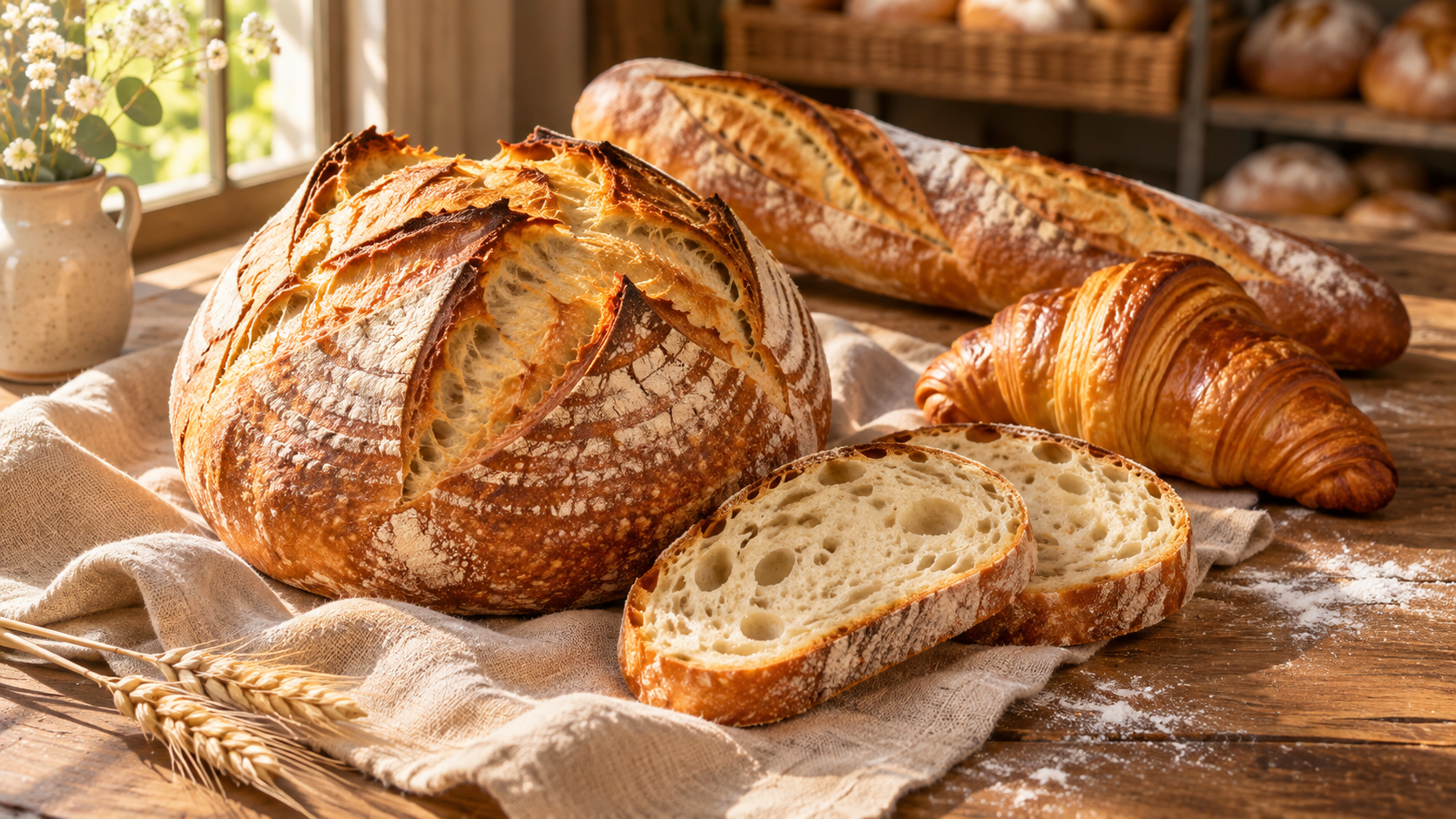
Abstract: A rotary rack oven, also called a rotary oven or revolving oven, works by turning a loaded rack through a chamber of circulating hot air. Products stay still on their trays; the trays rotate through the heat. This article covers what it is, how it differs from deck and tunnel ovens, how to calculate capacity, steam and energy per kilogram, where it performs well, and where it does not.
On this page: rotary rack oven definition, working principle, rack vs deck vs tunnel, capacity calculation, steam and energy per kilo, strengths and limits, mixing cake and bread in one oven, what drives uniformity, and what to send for a quote.
What Is a Rotary Rack Oven?
A rotary rack oven is a batch baking chamber built around a rotating platform. A full-height rack of baking trays is pushed in, and the platform lifts and turns it while hot air is blown through the load by a circulation fan. The chamber stays closed for the entire bake, and loading and unloading happen between batches.
It is distinct from the two ovens it is often compared with. A deck oven bakes on static hearths, where heat comes by radiation and conduction from the bottom and the baker controls each deck separately. A tunnel oven moves product continuously on a belt or mesh through temperature zones. A rotary oven sits between the two: batch discipline like a deck, forced-air circulation like a convection oven, and a volume per square metre that neither can match.
This type of rotary oven is used across a broad product range — tin bread, toast, burger buns, croissants, cookies, mooncakes, maamoul and kahk are all commonly baked in it. That flexibility is why the machine appears in both small artisan bakeries and mid-volume plants.

How Does a Rotary Rack Oven Work?
Heat is exchanged, not open-flame
In an indirect-fired oven, the burner or electric elements heat a heat exchanger, and the circulation fan pushes air across it and into the baking chamber. Combustion gases do not enter the chamber, so the bake is convective rather than direct-fired. The heat exchanger also stores heat and continues releasing it between batches, which shortens recovery time.
Rotation compensates for uneven airflow
Air distribution inside any closed chamber is uneven. Corners run cooler, and the fan side runs hotter. Rotating the rack makes this unevenness irrelevant, because every tray passes through the same hot and cool zones in the same order. This is the mechanical reason a rack oven bakes evenly from top to bottom, and why the drive and the turntable bearing are parts worth inspecting during maintenance.
Steam is timed, not continuous
Steam injected at the start of the bake keeps the dough surface moist and elastic long enough for oven spring, then gelatinises the starch film that later forms the crust. Steam is a timed function of the recipe. Too little gives a dull, tight crust, while too much gives a pale, blistered surface and a soft skin.
Rotary Rack Oven vs Deck Oven vs Tunnel Oven
| Aspect | Rotary rack oven | Deck oven | Tunnel oven |
| Heat transfer | Forced convection through a heat exchanger | Radiation and conduction from the deck | Convection and radiation across zones |
| Baking mode | Batch, one profile per chamber | Batch, per-deck control | Continuous |
| Typical capacity | Medium to high, in batches | Low to medium | High and steady |
| Typical products | Bread, buns, viennoiserie, cookies, mooncakes | Artisan hearth bread, pizza, deck-contact products | Single-product, high-volume lines |
| Steam | Timed injection, whole chamber | Per deck, manual or timed | Zoned |
| Footprint | Vertical: small floor area, uses height | Wide | Long |
| Changeover | Fast: swap the rack | Deck by deck | Slow: the line must clear |
| Main limit | One profile at a time | Labour and deck management | Product changeover and minimum run length |
How Do You Calculate Rotary Oven Capacity?
Three equations do most of the work:
- Batch weight (kg) = trays per rack × pieces per tray × piece weight (kg)
Assume 6 pieces per tray: 32 × 6 × 0.35 = 67.2 kg per batch. With a 25-minute bake and 5 minutes to swap racks, one cycle takes 30 minutes, so two batches per hour — about 134 kg/h.
Example 2: 60 g croissants in the same oven
Assume 12 pieces per tray: 32 × 12 × 0.06 = 23 kg per batch. An 18-minute bake plus 2 minutes handling gives three batches per hour — about 69 kg/h.
Same machine, half the throughput, because piece weight and bake time changed. This is the calculation buyers most often skip, and it explains why two suppliers quoting the same 32-tray oven can mean very different output.
Catalog capacity is not real capacity
Add the time a rack spends waiting for the proofer, the minutes lost after a cold start, and the fact that changeovers cluster at shift start. Our
capacity calculation
guide treats the oven as one section of a balanced line rather than as a standalone number. What Steam Load and Energy per Kilo Should You Plan For?Energy per kilo is the number that makes quotations comparable: rated heating input (kW) × bake time (h) ÷ batch weight (kg) = kWh per kg. A 54 kW oven on a 30-minute cycle with a 67 kg batch works out at about 0.40 kWh per kg. The number is illustrative, but the formula lets you test any quotation against your own product.
Two specifications move this figure more than burner size. Insulation: the HM-32 series uses 135 mm rock wool at 100 kg/m³, which limits standby loss between batches. Air management: adjustable dampers and two fan speeds let operators slow circulation for delicate products and increase it for dense doughs, instead of running the fan at full speed for everything.
On steam, ask for steam capacity per hour and the water quality requirement. Steam output has to reach the full height of the rack, not just the middle, and untreated hard water scales the generator faster than any other failure point in the oven.
Why Use a Rotary Oven?
Batch flexibility at medium-high volume
One chamber, one profile, but a new product every 30 minutes. For a bakery running bread in the morning, buns at midday and pastries in the afternoon, this beats a tunnel oven that needs a long run to be worth starting.
Crust and oven spring
Steam plus strong initial heat gives the volume and gloss that a static deck struggles to reproduce across a full rack.
Floor space
Capacity grows upward. A machine holding 32 trays of 400 × 600 mm occupies roughly 1.6 × 2.75 m of floor, so the binding limits become ceiling height and hood design rather than production area.
One operator, one rack
Loading happens outside the hot chamber. The operator builds the rack at the bench, wheels it in, and unloads after the bake, which removes the reach-into-a-hot-deck motion that limits deck oven throughput.
Where Does a Rotary Oven Perform Poorly?
When production must never stop
A rack oven is a batch machine. If the line needs steady output hour after hour with no gaps, the right answer is a
bread production line
built around a tunnel oven, not a larger rack oven. When one bake has to run mixed profiles
Everything in the chamber shares one temperature curve. Baking a delicate sponge and a dense rye loaf at the same time means compromising both.
When products dry out under moving air
High airflow is unforgiving to meringues, some sponge types, and unglazed items with high surface area. Slow fan speeds and shorter cycles help; they do not turn the machine into a deck oven.
When the building cannot take the load
Check practical details early: a 380 V three-phase supply, a hood rated for the oven, floor loading for a machine of around 1.9 t, and enough height for a rack to be rolled in upright. These are the items that turn a two-week installation into a two-month one.
Can You Bake Cake and Bread in the Same Oven?
Yes, with scheduling discipline. The chamber does not care what is inside it, but the recipes do. Bread wants steam and a hot start, while most cakes want a gentler ramp and no steam on the surface. Bake them in separate batches with their own programmes rather than sharing a cycle, and keep cake tins on their own racks so tray spacing stays consistent. Bakeries running both usually treat the oven as a shared asset with a fixed sequence, not as a flexible one. Cake-specific work usually sits in a different part of the plant, which is why sponge and batter production is normally paired with
cake and cookie equipment
upstream. What Determines Bake Uniformity?
Airflow balance
Even rotation cannot fix a poorly balanced chamber. Look for a duct design that delivers air across the full rack height, and for dampers that can be adjusted per product and season. The HM-32 series uses three-stage air adjustment for exactly this reason.
Rack loading pattern
An unbalanced rack — full at the bottom, empty at the top — changes the airflow path and the bake. Load symmetrically and keep the same tray positions between batches.
Recovery between batches
Uniformity drifts when the oven is asked to start the next batch before the heat exchanger has recovered. The insulation specification and the gap between bakes matter as much as the thermostat setting.
What Information Should You Provide for a Quotation?
Products and piece weights, with the tray or mould size for each.
Final Thought
A rotary rack oven is the right machine when the product range is defined, the volume is real, and the plant can accept batch discipline. Before signing, confirm three things: that the capacity figure was calculated from your piece weights and bake times rather than from a brochure; that the steam and airflow specification matches your most difficult product rather than your easiest; and that the site can physically take the machine — power, hood, floor and height. Get those three right and the oven becomes the most predictable section of the line. Get them wrong and no amount of programming will recover the bake.
Rotary Ovens from Haopai
The HM-32 series is offered as HM-32E, HM-32D and HM-32G, with 32 trays of 400 × 600 mm, a 380 V three-phase supply, 135 mm rock wool insulation at 100 kg/m³, and overall dimensions of 1600 × 2745 × 2750 mm at a net weight of 1900 kg. Standard features include a dedicated air duct for even temperature distribution, three-stage air adjustment ports, and fast and slow fan speeds; variable-frequency air control and a dual steam system are available as options. Typical applications include maamoul, kahk, cookies, croissants, burger buns, tin bread, bread rusk, toast and mooncake. The oven is normally specified together with a
spiral mixer
upstream and a flow wrapping machine downstream. Haopai equipment is CE and ISO certified and supported by overseas installation and after-sales service. Need Help Specifying a Rotary Oven?Send your product list, piece weights, tray size and target hourly output, and we will return a configuration with the batch calculation behind it, including the
rotary oven
model that fits your bake. If you are still comparing oven types, the bread production line buying guide explains how the oven decision affects the rest of the line.Share to:


