Turnkey Bakery Production Line: What Is Included from Design to Commissioning
A turnkey bakery production line includes process design, equipment selection, layout and utility planning, installation, commissioning and operator training. Here is what each stage should deliver before you sign.
2026/11/12
Reading volume: 0
News Details
A turnkey bakery production line is not just a collection of machines. It is a project execution model in which a single team takes full responsibility for the process route, equipment selection, plant layout, utility integration, installation, and production startup — ultimately delivering a line that runs stably at the agreed output. For buyers comparing quotations, the key question is not merely how many machines are included, but which project stages are covered and who is accountable for each. This guide walks through the six standard stages of a turnkey bakery project, what deliverables each stage should produce, and where projects most commonly cause delays.
What a turnkey bakery production line truly encompasses
A complete project can be evaluated against six core work packages:
- Product and capacity definition — including product range, formats, weights, and target hourly and daily output.
- Process route and equipment selection — including required production sections, their sequence, and rated capacity.
- Layout and utility planning — including machine positioning, conveying direction, drainage, power, gas, compressed air, and exhaust systems.
- Manufacturing and factory testing — including fabrication, assembly, trial runs, and inspection before shipment.
- Installation and commissioning — including equipment placement, connection, calibration, and trial production.
- Acceptance, training, and after-sales service — including capacity and quality verification, operator training, documentation, and spare parts support.
If a proposal omits any of these items, the gap will typically resurface later as a change order or an unforeseen production bottleneck.
Stage 1: Product range and capacity definition
All downstream decisions depend on two fundamental inputs: what products you bake and how much you must deliver. Product formats determine the process route — a laminated croissant and a tray-baked sponge cake share almost no common equipment — while target output defines the rated capacity of each production section.
Buyers should clearly distinguish between normal hourly output and peak output, specify the number of SKUs, and define the size and weight range for each product. Product mix is as critical as volume: a line sized for a single product running at full speed will perform very differently when it requires three changeovers per day.
Stage 2: Process route and equipment selection
Once product specifications and capacity are finalized, the equipment configuration follows logically. A bread-focused project typically requires mixing, dividing, forming, proofing, baking, cooling, and packing sections; a pastry-focused project needs sheeting and laminating equipment instead of heavy-duty dividing machines; a cake-focused project requires batter preparation, depositing, and cutting equipment.
Typical production sections include:
- Mixing section: an automatic spiral dough mixer for continuous dough supply, or planetary mixers for batter-based products.
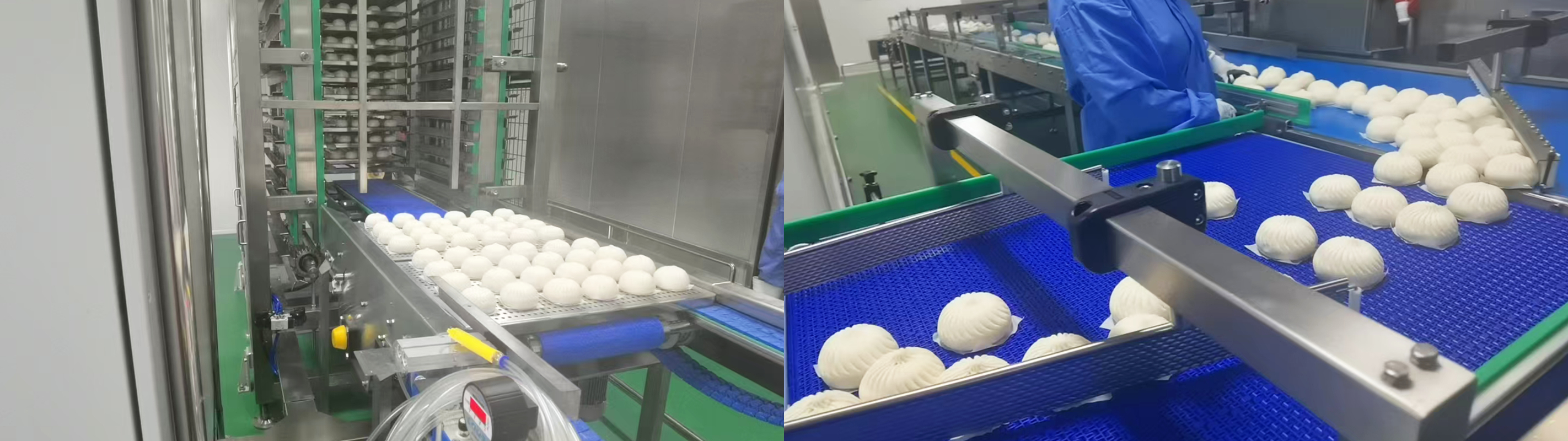
- Forming and depositing section: a turnkey bread production line for pan bread and multi-layer bread varieties, a croissant production line for laminated pastry, an automatic cake depositor for batter products, or a steamed bun and stuffed bun production line for filled staple foods.
- Baking section: tunnel ovens for continuous production, or a rotary oven for scenarios where batch flexibility and product variety are prioritized over uninterrupted flow.
- Cooling and packing section: cooling conveyors paired with an automatic flow packing machine when the line must interface with retail packaging downstream.
The core engineering principle is capacity balancing, not maximum speed. An oven may have a higher baking capacity than the proofer can supply, while the packing section may be slower than the output of the cooling conveyor. Each section’s capacity should be matched to the target output, with appropriate buffer zones where product requires resting time.
Stage 3: Layout design and utility planning
Layout work translates the process route into a physical factory drawing: machine footprint, operator movement paths, maintenance access, conveying direction, and the location of every utility connection. Two constraints determine most layouts: available floor space and existing building infrastructure.
Before finalizing the design, buyers should confirm ceiling height, floor load capacity, drainage locations, power supply capacity, gas supply, compressed air availability, exhaust requirements, and space reserved for future expansion. Modifying a machine position on paper costs nothing; relocating it after delivery costs weeks. Capacity balancing and layout design should be finalized together, which is why a capacity calculation is typically completed before detailed drawings are released.
Stage 4: Manufacturing, factory testing, and delivery
A turnkey project should include on-site assembly and trial running before shipment, not just component fabrication. Factory testing is the last low-cost opportunity to identify issues such as incorrect conveyor direction, mis-sized molds, or control sequences that do not align with product recipes.
Buyers should ask what will be tested, which product will be used for testing, and what evidence will be provided — including test records, photos or videos of the trial run, and a detailed inspection checklist. Packaging, loading plans, and documentation such as electrical drawings, operation manuals, and spare parts lists also fall within this stage.
Stage 5: Installation and commissioning
At the customer’s facility, commissioning is the phase where the line transitions from being a collection of equipment to an integrated production system. The process typically follows this sequence: mechanical placement and leveling, electrical and utility connection, dry running, trial production, and adjustment of speed, temperature, and timing parameters based on actual product recipes.
Overseas buyers should agree in advance on who will perform each task, what the buyer is responsible for providing — including power, water, gas, lifting equipment, and local labor — and what documentation will mark the closure of this stage. A written installation and commissioning checklist eliminates most disputes regarding site readiness.
Stage 6: Acceptance, training, and spare parts management
Acceptance criteria should be measurable: agreed hourly output, product weight tolerance, appearance and baking consistency, and stable operation over a defined testing period. Training should cover equipment operation, product changeover, cleaning procedures, and basic maintenance, and it should be conducted using the buyer’s own recipes rather than sample demonstration dough.
Spare parts planning is also part of this stage. Wear parts, recommended inventory levels, and lead times for critical components determine how quickly a line can recover from unexpected downtime.
What information to send a supplier before requesting a proposal
A supplier cannot accurately size a line without detailed data. The minimum required information package includes:
- Product list with shapes, weights, and target baking profiles.
- Normal and peak hourly output, as well as shift schedule.
- Factory floor plan with dimensions, ceiling height, column positions, and drainage locations.
- Available power, gas, water, compressed air, and exhaust conditions.
- Packaging method and any downstream material handling requirements.
- Cleaning and hygiene standards, plus applicable certification requirements.
Send the same information package to every supplier. This ensures quotations are directly comparable, and the cost factors behind each price become transparent instead of being obscured by differences in project scope.
Why a single coordinated supplier reduces project risk
Splitting a project across multiple suppliers may appear cheaper at the quotation stage, but it typically costs more during installation. Interface issues — such as conveyor height mismatches, signal communication gaps, speed misalignment, and unclear responsibility for downtime — are exactly where project timelines slip.
A single coordinating supplier reviews the entire production route before manufacturing begins, resolving layout conflicts while they still exist only on paper. In one reference project, a customized multi-function line provided for Sunfu Food replaced semi-manual processing, increasing output by 300% while reducing waste to 2.5% and cutting labor costs by 65% — these gains came as much from integrated line design as from the performance of individual machines.
Common pitfalls in turnkey bakery projects
Three recurring issues account for most project failures. First, capacity is defined as a single static number, leaving the line unable to handle real-world product mix variations. Second, utility and layout requirements are confirmed after equipment has already been ordered. Third, acceptance criteria are never formalized in writing, leading to open-ended commissioning periods. Each of these problems is avoidable with clear documentation agreed upon before the purchase order is issued.
Next steps
If you are planning a new bakery plant or upgrading an existing facility, begin with product and capacity data, then request a process route and layout proposal rather than a simple machine list. Haopai designs and manufactures complete bakery production lines for bread, pastry, cake, and filled products, with CE and ISO certified equipment and overseas installation support. Share your product list, target output, and factory floor plan to start a project review — or schedule a trial run at our factory using your own ingredients.
Share to:


