Minimizing Bakery Waste: Yield Loss Points From Mixing to Packaging
Bakery waste is generated during mixing, depositing, cutting, weight control, and changeover. This article explains how yield is lost at each stage, and which equipment and controls can recover it.
2026/11/18
Reading volume: 0
News Details
Summary: Bakery waste rarely looks like a pile of discarded product. It hides in dough left in the mixer, batter degassed by rough pumping, edges trimmed away at the cutting station, portions packed a few grams overweight to stay inside tolerance, and the unreliable first pieces after every changeover. Reducing bakery waste means attacking each of those losses at its source — and the equipment choices that matter most are depositing precision, cutting technology and weight feedback, not the recipe.
In this guide: what counts as waste on a line, what a few percent actually costs, where dough waste starts, how depositing precision controls yield, why cutting creates trim, what aeration does to batter loss, why giveaway is the most invisible waste, how changeovers create losses, and what to measure.

What Counts as Waste on a Bakery Line?
Five categories, and they behave differently:
- Scrap dough and batter — over-mixed batches, mis-scaled divider pieces, dough left in bowls and hoppers at shutdown.
- Trim — edges and offcuts removed to make geometry consistent: sheet edges, first and last pieces, irregular end slices.
- Giveaway — product packed above declared weight to guarantee compliance. It leaves the plant as saleable goods but at the bakery's cost.
- Rejects — pieces lost to poor appearance: torn edges, smeared fillings, collapsed layers.
- Stops and rework — blade cleaning, restarts and unmade product while the line is down for a waste-related reason.
The first two are visible and get managed. The last three are usually larger, and they are where bakery production waste quietly becomes a margin problem.
How Much Does a Few Percent Actually Cost?
Waste arithmetic is small numbers multiplied by long hours. Illustrative example, with all figures assumed: a cake line producing 400 kg of product per hour with a combined giveaway and reject rate of 3 percent loses 12 kg of product an hour. Over two shifts and 300 days, that is roughly 57,600 kg a year — of product that was mixed, baked and handled at full cost but never sold at full value. Halving that rate is usually a controls-and-equipment project, not a staffing project, which is why yield belongs on the same agenda as throughput.
Where Does Dough Waste Start — Before the Dough Is Mixed?
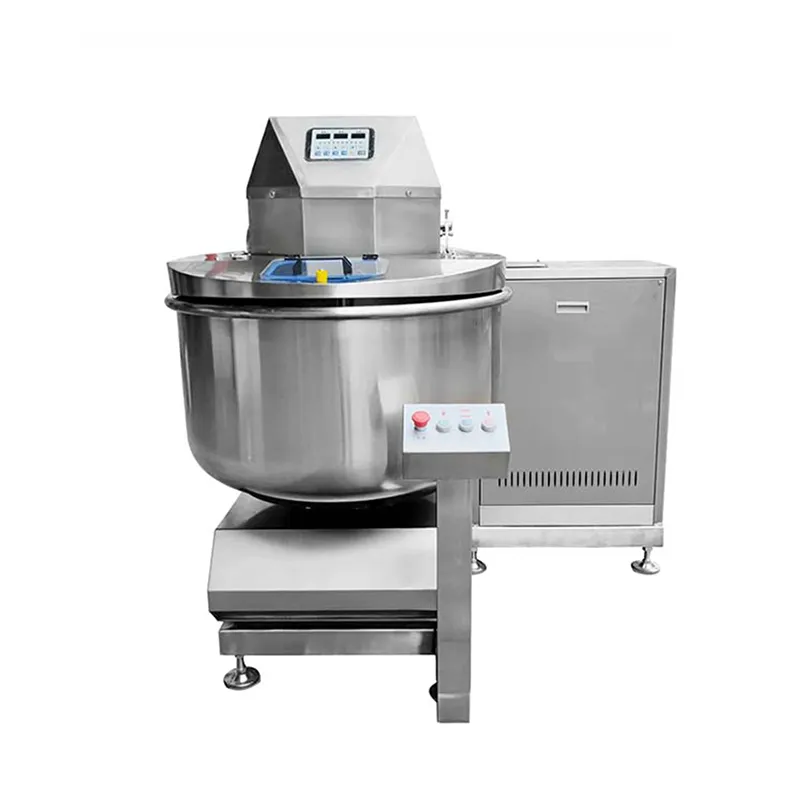
Dough waste reduction begins with scaling. Divider accuracy, dough temperature and consistency of batch size decide how much correction the rest of the line has to do. A divider running outside its weight tolerance forces operators to either reject pieces or merge them, and both choices cost yield. Consistent mixing — a properly sized automatic spiral dough mixer matched to batch sizes — keeps dough development uniform, which keeps dividing and moulding predictable downstream. The cheapest kilo of waste to save is the one never created at the mixer.
How Does Depositing Precision Control Waste?
On batter products, the depositor is the single largest source of both scrap and giveaway. Two behaviours matter:
- Volumetric accuracy. Well-maintained servo-driven depositors typically hold portion variance below one to two percent, which is the difference between packaging that passes checkweighing first time and packaging that has to be corrected or overweighted.
- Gentle handling. Highly aerated batters lose volume if they are pumped or dropped aggressively; denser batters need more extrusion pressure. A depositor whose pressure, speed and stroke are programmable per recipe can serve both without compromise.
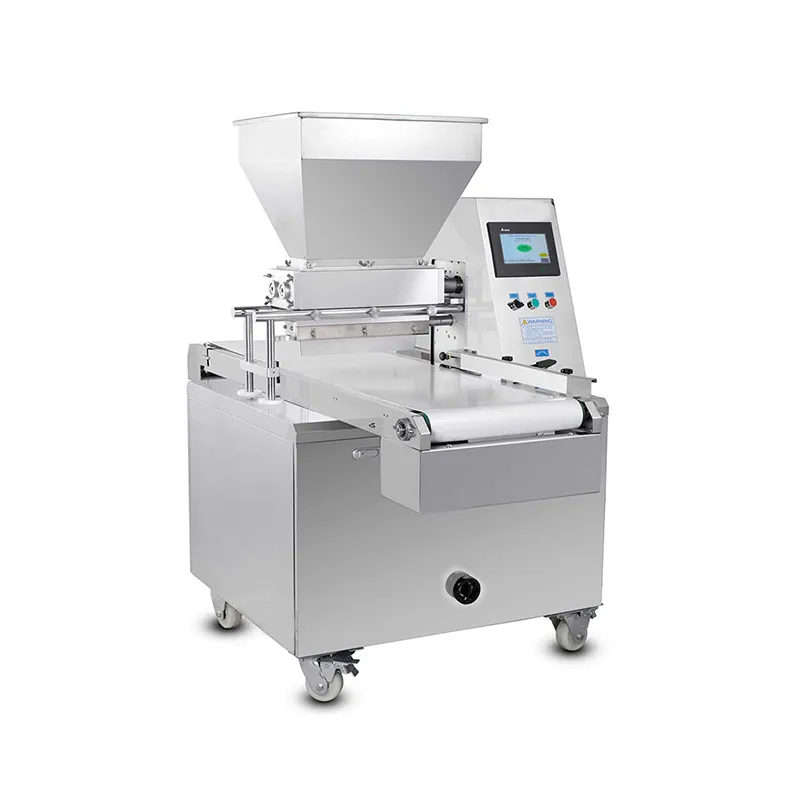
First-off checks at startup and after every recipe change catch drift before it becomes a full tray of rejects. For choosing between piston, volumetric and servo designs, our cake depositor machine selection guide compares the options, and the automatic cake depositor shows the programmable-pressure approach in practice.
Why Does Cutting Create Trim — and How Do You Reduce It?
Trim is not always caused by a wrong cutting programme. Often the cut position is correct, but the product does not separate cleanly: a conventional blade drags through sticky fillings, compresses soft crumb, and tears layers that respond differently to pressure. The visible scrap is only part of the loss — operators slow the line, clean blades between runs, and reject portions that no longer meet presentation standards, and every one of those behaviours consumes yield.
Ultrasonic cutting waste reduction works at the blade itself: a high-frequency vibrating blade separates product with far less friction, so fillings stay in place, layers stay defined, and residue stops building up between cuts. For cream-filled cakes, layered bars and soft sandwich portions it is usually the first upgrade with a measurable yield return. See the automatic ultrasonic cake cutting machine for the machine-level view, and our articles on why ultrasonic cutting matters and high-speed ultrasonic cutting technology for the production results.
Two process conditions decide whether even the best cutter performs: product temperature at the cut point, and stability of infeed. A cake that cuts cleanly chilled may smear warm; a blade cannot compensate for product moving under it. Control both before blaming the blade.
What About Batter and Aeration Loss?
Aerated batter is yield-sensitive in both directions. Under-aerated batter bakes dense and heavy — weight is fine, volume and texture are not. Over-aerated or roughly handled batter collapses at depositing and creates rejects. Dedicated aeration systems control density where it is created: an industrial cake aeration system whips batter to a target density before depositing, so the depositor works on a consistent product instead of absorbing the variation. Our article on the cream and chocolate aeration system covers the same principle for fillings.
Is Giveaway the Most Invisible Waste?
Giveaway never appears in a scrap bin, which is why it survives longest. Every portion packed above declared weight is product given away at production cost. Portion weight control bakery practice is straightforward:
- Verify deposit or incoming unit weight before cutting, not after packing.
- Check portion dimensions immediately after cutting.
- Confirm packed net weight at the packing machine, with a checkweigher feeding corrections back upstream.
One discipline matters more than the rest: do not manage to the average. Two runs can share the same mean weight while one has far wider variation and far higher compliance risk. Monitoring the spread — standard deviation, out-of-specification portions, giveaway per thousand units — shows where the loss really is. A consistent overweight across all portions points upstream to deposit weight; torn edges point to cutting conditions, blade condition or product temperature.
How Do Changeovers Create Waste?
The first pieces after a changeover carry the highest risk of the whole shift: new recipe, new tray or pattern, settings that depend on operator judgment. Documented recipes — product orientation, guide positions, cut pattern, blade selection, speeds and inspection limits — turn changeover from a judgment exercise into a repeatable one, and physical references beat eyeballing every time. Where trim is unavoidable, it should be measured and, where food safety rules allow, repurposed: sheet offcuts into crumb toppings or inclusions recover value that the bin would otherwise take. Bakery trim reduction starts with knowing how much trim exists, which most lines have never counted.
What Should You Measure?
Waste that is not counted is not reduced. A working minimum:
- Planned versus actual yield per batch and per shift.
- Average unit weight and its spread, at depositing, after cutting and after packing.
- Reject count by reason: appearance, weight, geometry.
- Trim collected, by station.
- Stops caused by blade cleaning or restarts, with duration.
These numbers connect the visible cut to the financial result — and they are exactly the data a supplier needs to size a cake production yield improvement correctly.
What to Send a Supplier Before Requesting a Proposal
- Product list with piece weights, formats and target appearance standards.
- Current yield and waste data, if it exists — including trim and giveaway estimates.
- Target output per hour and shift pattern.
- Products that cause the most trouble: the sticky, filled, layered and delicate ones.
- Downstream packing method and any compliance weight limits.
- Hygiene requirements and applicable certification needs.
With those six items, a supplier can quote yield behaviour alongside price, and the cost factors behind each quotation become comparable.
Final Thought
Waste reduction in a bakery is a measurement project before it is an equipment project: count trim, weigh the spread, log the rejects. Then the equipment decisions become obvious — a depositor accurate enough to pass checkweighing first time, a cutter that does not tear the product it is paid to sell, an aeration system that stabilises density where it is created. Get the measurement right and the yield follows.
Yield-Focused Equipment from Haopai
Haopai builds the equipment that acts on each waste source: the automatic cake depositor with programmable pressure and stroke for recipe-by-recipe accuracy, the ultrasonic cutting machine for clean separation of filled and layered products, the butter cookie depositor for extruded products, and industrial aeration systems for batter and filling density control — all available within cake and cookie production equipment, CE and ISO certified, with overseas installation and after-sales support.
Want a Yield Review for Your Line?
Send your product list, current waste estimates and target output, and we will return a configuration that addresses the two or three losses costing you the most — starting with precision depositing and cutting, where most recoverable yield sits.
Share to:


